
Opera Talks: Yenny Otero
Usability is a hot topic these days – the word alone gets over 48 million hits on Google. But what does it really mean? We decided to go to Opera's resident usability guru Yenny Otero to get the lowdown on human-computer interaction. Our conversation ranged well into other media, however, including the future of TV!
Anna: Hola Yenny! Could you tell us your official title at Opera and what is it that you do?
Yenny: Hi there. My title is Senior Interaction Designer, which means that my job involves trying to understand how non-technical people use the Internet, and how to make a better browser for them.
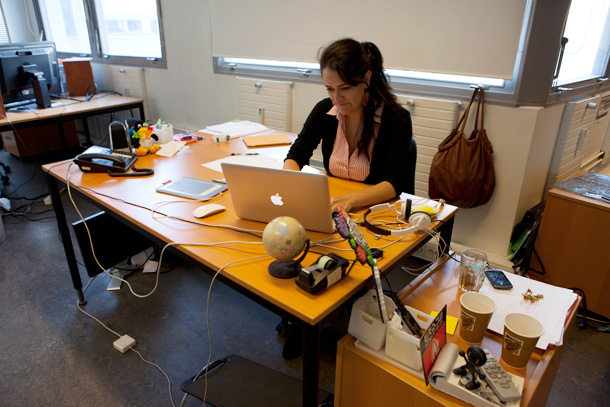
Yenny being non-technical at her desk.
Anna: What does usability mean to you as an interaction designer?
Yenny: It's a popular term among technical people at the moment as the new “solution to everything.” But usability is only one part of the whole picture. Before making something easy to use you should be sure that your product is useful and desirable in the first place.
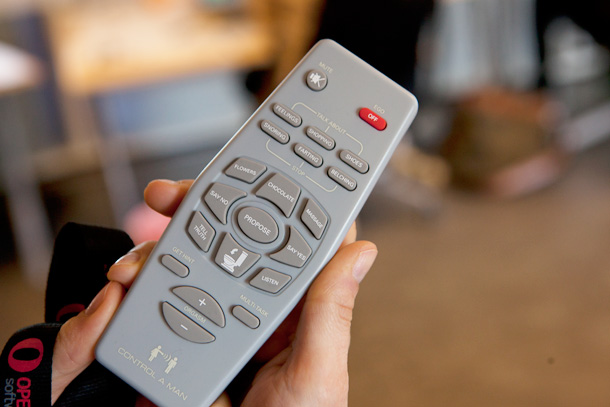
The Man Remote. The Ultimate Usability Tool to control your man.
Anna: What is involved for you in making Opera more usable, especially for people who aren't that tech-savvy?
Yenny: We are doing a variety of usability activities, including testing, as well as undertaking research and making observations, all in an effort to try to understand users.
Doing usability testing is really fun! You invite a person to give you their opinion about a new product, give them some tasks to complete and observe all details about what they do and say to get an insight into how they understand the system. Very often their understanding of the system (Internet, the browser, the computer) is completely different than yours and developers are always surprised to discover that something that seemed obvious to them is not understandable for less technical people.
The hardest part is to try to keep a "poker face" because you cannot give testers hints about how the system work so you have to pretend that you also don't know it well and they have to explain it to you, this is always really fun!
And it's really challenging because when you sit with someone in a testing situation, they want to know whether they are doing it “right,” but you can't coach them because your job is just to observe. Sometimes you have to tell someone, “I can't answer that question,” or “I'll tell you afterwards,” because you have to see how they would solve the problem on their own.
Anna: How have you seen usability evolve at Opera over time?
Yenny: There has been a big change – usability was something relatively unknown when I started at Opera 9 years ago. It went from being something that developers were supposed to know about, to something that individuals had responsibility for, to actually having a whole team dedicated to it with all the necessary resources.
Anna: What's your main focus at the moment?
Yenny: For me the biggest thing right now in usability is to understand the first impressions of all products we have: TV, desktop and mobile. Apart from usability, I am also working on the design of our new browser for TV which is lots of fun! I am also doing bits of work here and there for a mobile store and the desktop add-ons repository.
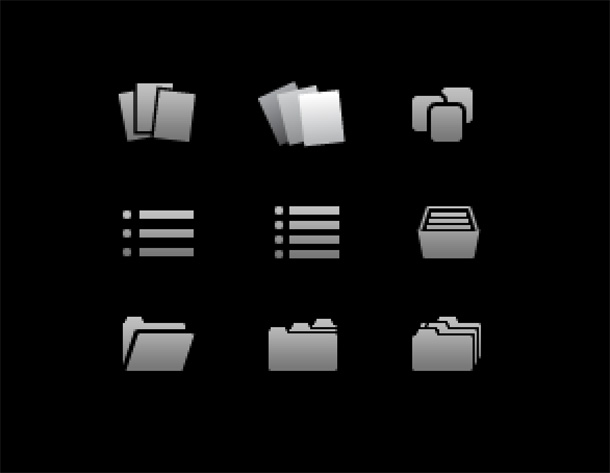
Designing icons. What should a category icon look like? Here are three versions.
Anna: Why do we need a special version of the browser just for TV?
Yenny: There are a number of reasons, but it really comes down to the fact that TV and Internet are very different media in terms of interaction. TV wasn't developed as a medium for interaction at all beyond changing channels! And now we have put the Internet in the TV, which raises a couple of big issues.
One, there is the factor of physical distance. With a computer, you sit very close to the screen and feedback comes to you almost instantly – it's the opposite for TV. The next issue is related to distance, and that is input. It's really difficult to type into a TV screen, and with the remote control all you can do is go up, down, left, right or use the numbers.
There is also the different use of TV and desktop. A TV is mostly used for entertainment and not much interaction while a PC is to "get things done" ... the current Internet is more designed for PCs than for idle TV entertainment.
Finally, there's the question of public and private. Computers were made for one person (that's why they're called PC's – personal computers) whereas TV is made for an audience of multiple people; a family group or bigger. How do you share the Internet in a group, for example? Alternately, as an individual user, how can you keep your own content private within a public space like a television? So all these questions make it challenging to bring TV and Internet together.
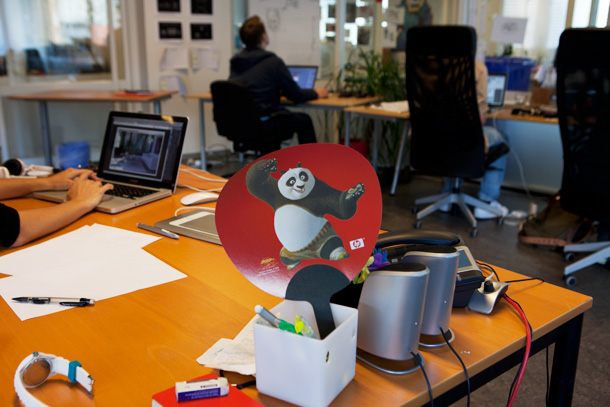
The Kung Fu Paddle. Smacks bugs away.
Anna: How do you see TV evolving with technology – as, presumably, it will have to?
Yenny: The use of a TV is already changing as users are no longer waiting for the TV show to be broadcast, but they want to decide what to watch and at what time... we will probably tell our children about those times where you had to follow the TV schedule or wait for the advertisement to finish!  Internet brings to TV much more interesting and personal content as you will be able to follow what your friends like or even watch it together from different locations. Internet will make our TVs more social, more personal... more useful
Anna: Last but not least, the traditional question in any Opera Talks interview. What's your favorite feature in Opera?
Yenny: I discovered that it is making keywords for searches, and works like this:
- Right click on a search field on a page where you search often, for example I use often tiny URL for making addresses shorter
- Select the option "Create search"
- Add as keyword something that reminds you of the action, for example "tiny"
- Press OK
Anna: Thank you, Yenny!
Readers' comments 22
Left under the original article, as archived.
About this article
| Published in | Choose Opera |
|---|---|
| Date | September 9, 2011 |
| Author | Anna Rohleder |
| Tags | interaction design, design, tv, opera talks, UX, Yenny Otero |
| Original | Internet Archive |
widowildFriday, September 9, 2011 1:35:43 PM
dizFriday, September 9, 2011 1:43:36 PM
نگاه منFriday, September 9, 2011 1:51:48 PM
techlawsamFriday, September 9, 2011 2:16:34 PM
Krzysztof HankiewiczFriday, September 9, 2011 3:00:30 PM
Yeni SetiawanFriday, September 9, 2011 5:38:44 PM
Ashwin LSaturday, September 10, 2011 7:33:28 AM
huxrSaturday, September 10, 2011 5:37:09 PM
Also, a systematic review of your mobile/desktop UIs would show lot of small hindrances and lots of ways to improve those parts.
Orphan features should be brought up to speed with modern requirements. Like Notes integrated with Bookmarks, Contacts, synching them to phone platforms that support them, My Opera social features integration, automatic Mini/Mobile session/history transfer to desktop, etc.
And Opera could unleash the power of their cloud services and social network with new features and much better integration with their browsers (especially Mobile/Mini).
Meanwhile, you should be at the forefront of user privacy protection against forever-tracking companies that are omnipresent on the web.
Also, it should be delivering a best-in-class developer experience, even if for a fee.
But they should also offer embedded Opera to OEMs for free, ad-supported and/or with their third-party apps/vids/etc distribution channel.
huxrSaturday, September 10, 2011 5:50:08 PM
Read some of the good investigative journalistic articles on TheRegister.co.uk about Symbian and Nokia and some of the sources.
Opera is now the only big European software company with mass consumer software products and a global reach.
huxrSaturday, September 10, 2011 7:43:55 PM
Opera should be among the best in UX, while keeping to its high ethics. That latter one is a real differentiator also, compared to those abusive and arrogant companies I mentioned.
So Opera's ethics should also be given a more center stage position. I believe that "being ethical" can help sell products too. Even in USA, but even more so in Europe.
Smooth UX is as important as resource-consciousness and good features.
Charles SchlossSunday, September 11, 2011 5:47:03 AM
"non-technical people use the Internet, and how to make a better browser for them." not an easy thing to do as there are so many differnt ways people use a browser
I have the same thing for tinyurl, I have about 20 some odd custom searches in Opera, makes it hard for me to use another browser
JulianSunday, September 11, 2011 7:41:08 PM
BJMonday, September 12, 2011 12:10:51 AM
AmenelMonday, September 12, 2011 10:48:06 AM
If I were working in software usability, the first thing I would keep in mind is that the choices I make, no matter how hard I work to find them, might not suit each and every user. I think this quote from the interview says exactly so: "Very often their understanding of the system (Internet, the browser, the computer) is completely different than yours and developers are always surprised to discover that something that seemed obvious to them is not understandable for less technical people."
So I'd give them **choice**, i.e. the possibility to depart from what I've found to be the best way of doing things. Usability and choice go hand in hand in my book. I'm still waiting to get that single option in Tools > Preferences > Advanced > Tabs > Additional tab option, or in opera:config, that will allow me to not have Opera desktop automatically shrink and move the tabs I lock.
So yes, nice interview. But it only makes it even less understandable that this tiny detail that makes my browser so mush less usable hasn't been amended in five releases. So here I am, still using 10.63 when 12.00 is in pre-alpha.
Eddie LopezMonday, September 12, 2011 2:59:28 PM
http://my.opera.com/usability/blog/usability-interview-with-opera
Dilruba AhmedTuesday, September 13, 2011 9:30:24 AM
HenryThursday, September 15, 2011 12:26:44 PM
lol cracks me up.
Choice post choice interview, thanks Anna thanks Yenny!
I'll show it a thing or two by crikey.
Wait a minute ? Where's Woman Control ? lol
realaustinFriday, September 16, 2011 6:59:05 AM
ChrisMonday, September 19, 2011 10:25:37 AM
Originally posted by topdawg:
Because it's useless and pointless for just about everyone else. Just because YOU think something is important to you personally doesn't make it important to everyone else.So quit trolling.
AmenelWednesday, November 2, 2011 10:28:51 AM
Originally posted by Slamdex:
Yes, because YOU know what's important to everyone else. Did you even UNDERSTAND what I was talking about? I doubt it. Useless and pointless? How come it has been the way it was for so long before being changed? Come on, be serious. If users could only express what is important to other users, where are we going? Sorry, but you're utterly retarded if you think my post was trolling and yours isn't: just because you label it useless and pointless doesn't make it useless and pointless to all others and guess what, I'm sure you can't speak for "everyone else". Just go to the forum post I created about this and get schooled.ChrisMonday, November 7, 2011 10:48:25 AM
Originally posted by topdawg:
I clearly know more about it than you do, since unlike you, I am not claiming to know better than the people making the product. And isn't it funny how you only NOW think it's wrong to speak on behalf of other people? I mean, you only did it after I turned your own nonsense against you.Originally posted by topdawg:
Who gives a crap? Maybe they didn't figure out that this way was better until now. Maybe they did, but it had to wait until they had worked on other things. This is completely irrelevant. Something being in a specific way for a while doesn't mean it's the right way for the future.Originally posted by topdawg:
Um, hello? YOU are the moron who's bashing Opera for not adding a totally irrelevant option no one really cares about, and pretending that it's important to everyone else.Originally posted by topdawg:
You are the moron who started trying to speak on behalf of everyone else. I simply turned it around, and you are clearly a hypocrite who will gladly pretend to represent everyone else, but suddenly you get all angry about it when someone else uses it against you.أبوبكرعبدالله مى كنواTuesday, January 3, 2012 10:10:51 PM