
History 1994 – 2016
From a research project in Oslo to a browser on hundreds of millions of devices, and back to a small, loyal following when Presto ended.
1994
A research project at Telenor
At Telenor, Norway's national telecom company, Jon Stephenson von Tetzchner and Geir Ivarsøy start building a web browser as part of a research project. Their goal: a browser that runs well on ordinary, even old, computers. Opera later counted the browser's origin from this year, celebrating its 15th anniversary in April 2009.
1995
Opera Software is founded
Telenor decides not to continue the project. The two developers leave to found Opera Software in Oslo. Opera 1.00 is completed in April 1995, but it is only used internally and by a few testers.
1996
Opera 2.00, then 2.10
Jon von Tetzchner publicly announces Opera 2.00 on April 22, 1996: a shareware browser for Windows, with mail (SMTP) and news (NNTP) clients. Opera 2.10, released on December 9, 1996, adds frames, HTML 3.0, saved sessions and a zoom from 20% to 1000%.
1997
Opera 3.00
Opera 3.00, released on December 1, 1997, follows Opera 2.12 (February 1997), which had made it possible to turn off images, frames, animations and sounds.
1998
Opera 3.50 and CSS
Opera 3.50, on November 18, 1998, introduces Elektra, Opera's second rendering engine, with support for CSS 1, user style sheets, TLS, file upload, a download manager and an offline mode. Opera starts to be known as the small, fast alternative to Netscape and Internet Explorer.
1999
Håkon Wium Lie joins Opera
Håkon Wium Lie, who proposed CSS at CERN in 1994 and worked on it at the W3C, joins Opera as Chief Technology Officer. Web standards become part of Opera's identity. Opera 3.60 comes out in May, and a first beta for BeOS, Opera 3.65, in July.
2000
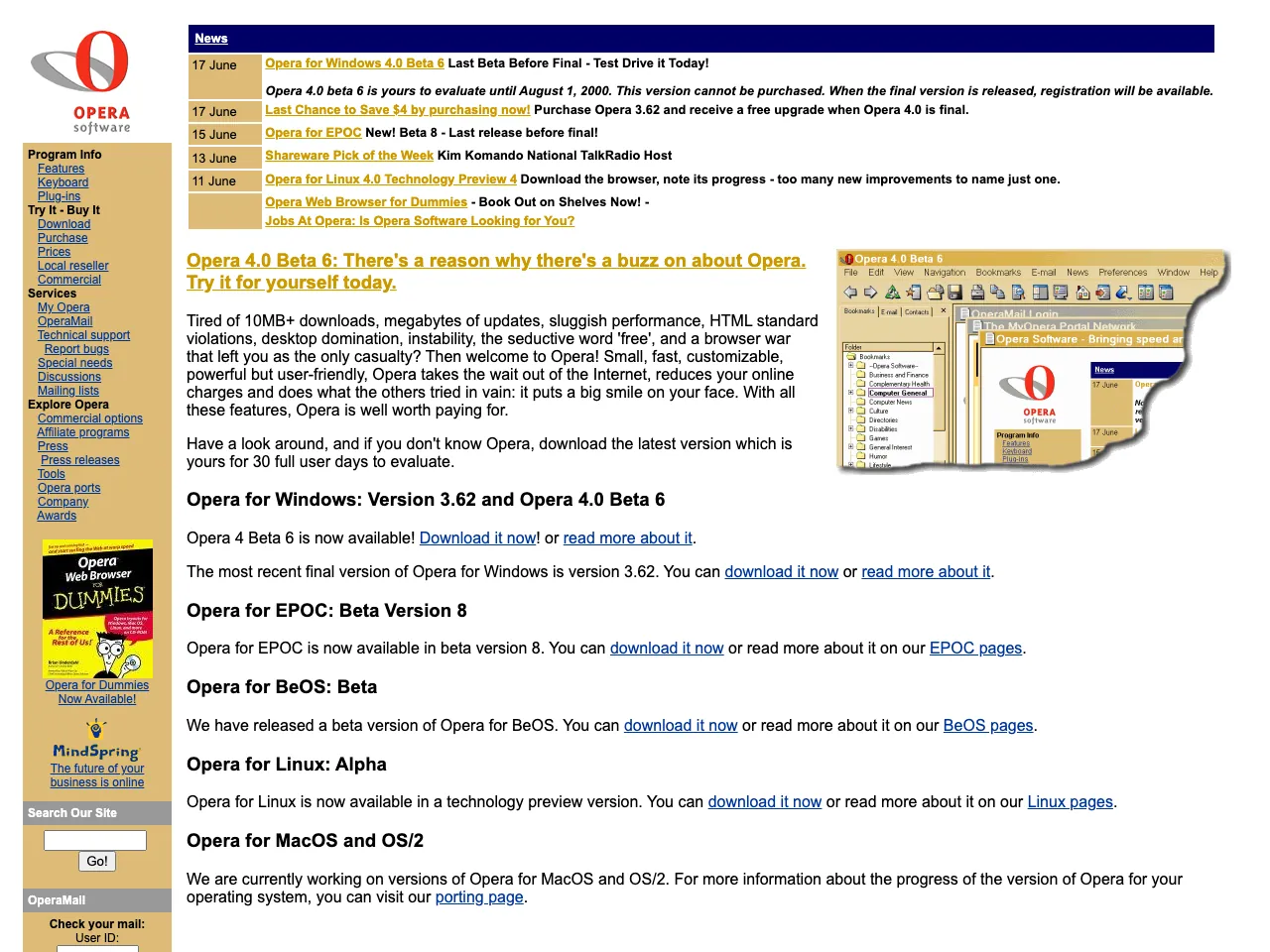
Opera 4.00: tabs, mail and a new core
Opera 4.00, on June 28, 2000, is rebuilt around a cross-platform core that opens the way to Linux, Mac and many smaller systems. It brings a built-in e-mail client, tabbed browsing, CSS 2, HTTP 1.1 and 128-bit encryption.
2000
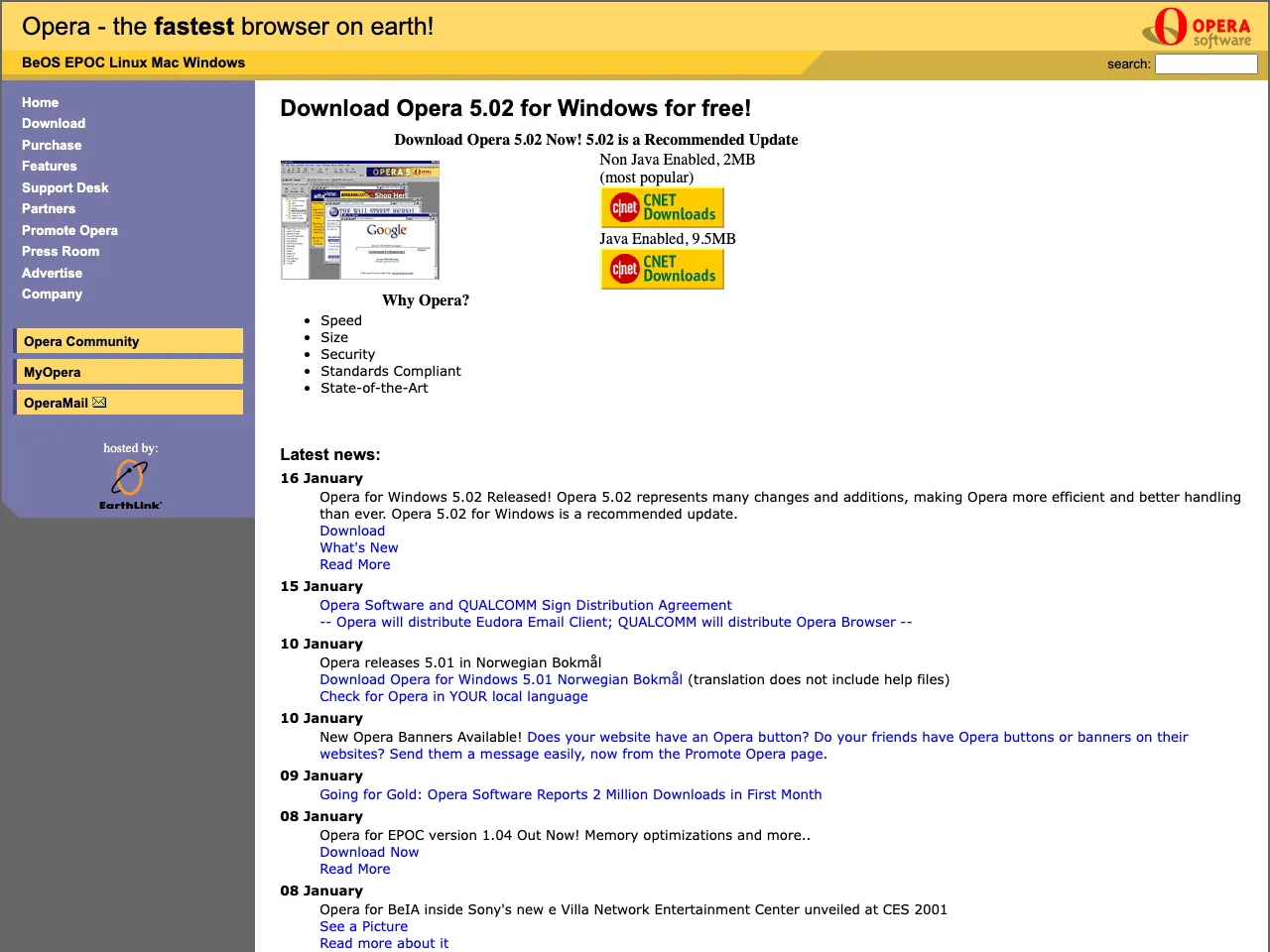
Opera 5.00, free with a banner
On December 6, 2000, Opera 5.00 becomes free to download for the first time, paid for by an advertisement banner in the toolbar; buying a license removes it. It also adds a search field to the toolbar and a built-in ICQ client.
2001
Mouse gestures and Opera 6
Opera 5.10, on April 10, 2001, introduces mouse gestures. Opera 6.00, on December 18, 2001, brings Unicode, the Hotlist panels, skins, the choice between a single-window and a multiple-window interface, and Small-Screen Rendering, the technology behind Opera on phones.
2003
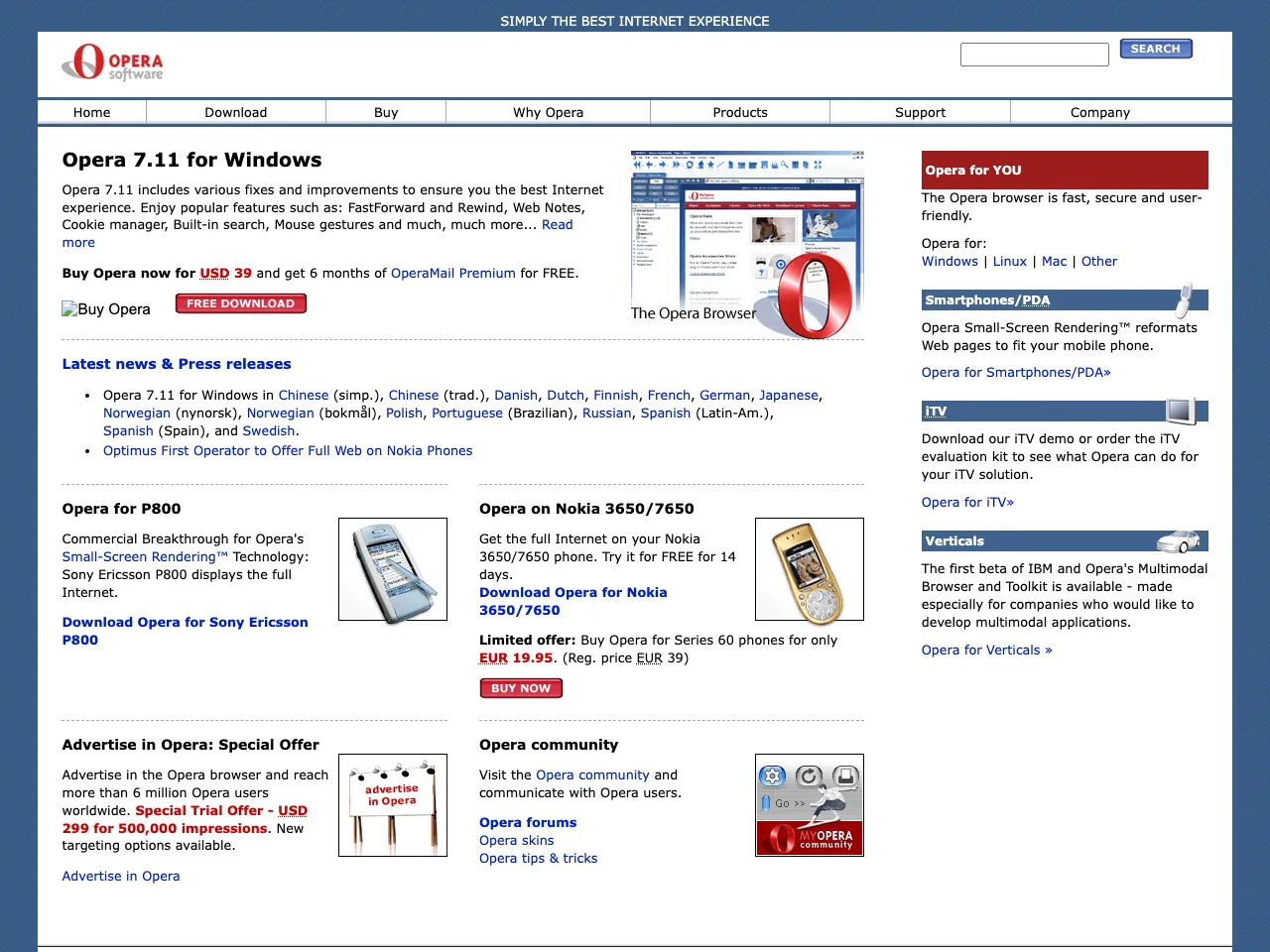
Opera 7 and the Presto engine
Opera 7.00, on January 28, 2003, is a complete rewrite around a new rendering engine, Presto, and a new mail client, M2. Presto will power every Opera product for the next ten years. On February 14, the Opera 7.01 "Bork" edition answers MSN.com, which served Opera users a broken page, by turning MSN into the language of the Swedish Chef. Opera 7.10, in April, adds the Wand password manager, Notes and Rewind.
2004
Opera 7.50 and the stock exchange
Opera Software is listed on the Oslo Stock Exchange on March 11, 2004, with the ticker OPERA. Its business rests on licensing Opera to phone makers and operators while selling the desktop browser. Opera 7.50, on May 12, 2004, adds RSS feeds, an IRC chat client and full-text search of mail; the 7.60 technical previews, from August, test voice control.
2005
Opera 8.00
Opera 8.00, released on April 19, 2005, brings security information in the address bar, voice commands, Fit to Window Width, User JavaScript and the first support for SVG. In July, the Opera 8.02 technical preview tests a built-in BitTorrent client.
2005
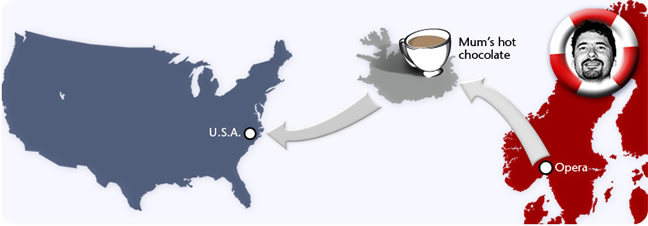
Swimming to America
On April 21, 2005, Jon S. von Tetzchner promises at a company meeting that if Opera 8 reaches one million downloads in its first four days, he will swim from Norway to the USA, with one stop for a cup of hot chocolate at his mother's in Iceland. Opera 8 passes the million, and on April 25 the CEO, in a wet suit, jumps into the Oslo fjord, escorted by Opera's PR manager in an inflatable raft. The raft punctures the next day, and the swim to America ends there.
2005
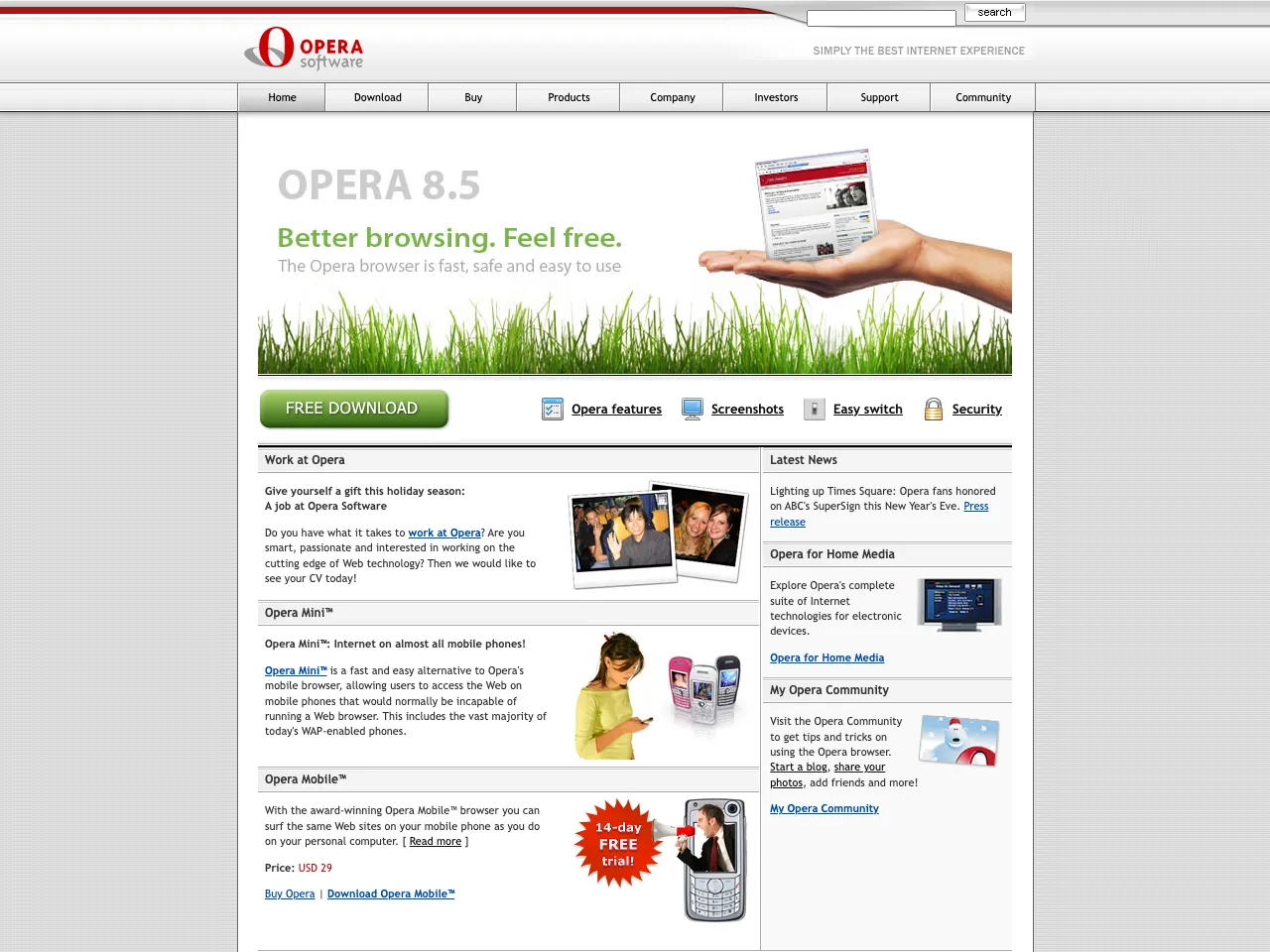
Opera 8.50 "Bolton": completely free
On September 20, 2005, Opera 8.50, code-named Bolton, removes the advertisement banner and the license fee: Opera's own version history calls it the first completely free version. Every later 8.5x release (8.51 to 8.54, until April 2006) is ad-free too. A month later, on October 20, the first Opera 9 technical preview introduces Presto 2.0.
2006
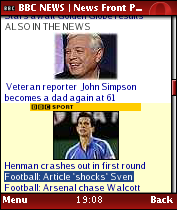
Opera Mini goes worldwide
Opera Mini, the Java browser that lets Opera's servers do the heavy work, launches worldwide in January 2006.
2006

Geir Ivarsøy passes away
Co-founder Geir Ivarsøy, who had written much of the early browser and its rendering engine, and who suggested the name Opera, dies of cancer on March 9, 2006. The Opera 9 weekly build of March 24 is released in his memory, and every Opera since version 9 says "In memory of Geir Ivarsøy" on its about page.
2006
Opera 9.00 (Merlin)
Opera 9.00, on June 20, 2006, adds widgets, BitTorrent, content blocking, site preferences, opera:config, <canvas> and Web Forms 2.0, and is the first Opera to pass the Acid2 test. Opera 9.10, on December 18, adds Fraud Protection.
2006
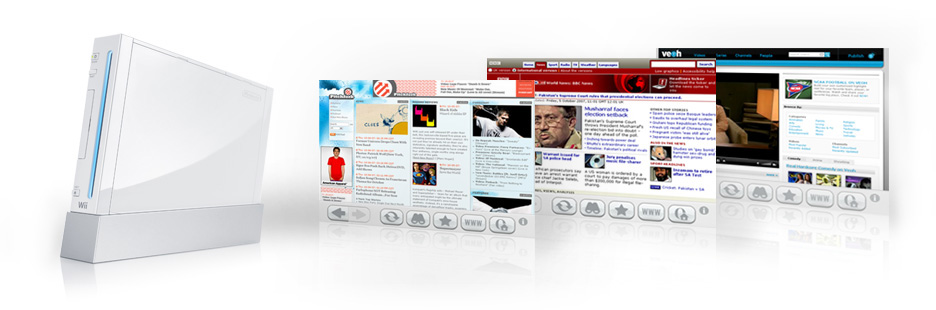
Opera on Nintendo consoles
The Nintendo DS Browser, made with Opera, goes on sale in Japan on July 24, 2006, and in Europe on October 6. On December 22, the Internet Channel of the Nintendo Wii, also powered by Opera, opens as a free trial; the full version follows on April 12, 2007.
2007
Speed Dial and Opera Mini 4
The Opera 9.20 beta introduces Speed Dial on March 28, 2007; the final version follows on April 11, with the first built-in developer tools. Opera Mini 4, with a full-page view of the real Web on ordinary phones, appears as a beta in June.
2008
Opera 9.50 (Kestrel), Link and Dragonfly
Opera Dragonfly, the developer tools, is announced on May 6, 2008. Opera 9.50, code-named Kestrel, follows on June 12 with Presto 2.1, the Futhark JavaScript engine, Opera Link synchronization and history search. On July 8, Opera launches the Web Standards Curriculum. Opera 9.60, on October 8, adds Feed Preview and the Scroll Marker; Opera MAMA, a study of the markup of 3.5 million web pages, is published in October.
2009
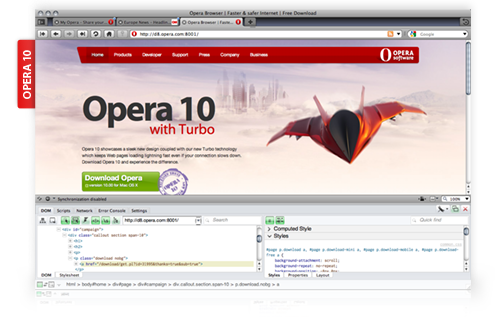
Opera 10.00 (Peregrine), Turbo and Unite
Opera 10.00, code-named Peregrine, is released on September 1, 2009, with a new design by Jon Hicks, visual tabs, automatic updates, inline spell check, Web Fonts, a 100/100 score in the Acid3 test and Opera Turbo, tried since a Labs release in March. Opera Unite, revealed on June 16, turns the browser into a web server; it is part of the final Opera 10.10 on November 23.
2010
Opera 10.50 (Evenes): Carakan and Vega
Lars Boilesen succeeds Jon von Tetzchner as Chief Executive Officer on January 5, 2010. Opera 10.50 for Windows, on March 2, brings the Carakan JavaScript engine, the Vega graphics library, Presto 2.5, private browsing and HTML5 video. The same month, Microsoft's browser choice screen in the European Union brings Opera to many new users. Opera 10.52 brings the same speed to Mac on April 27, and Opera 10.60, on July 1, adds WebM, geolocation and offline web applications.
2010
Opera Mini on the iPhone, 100 million users
Apple approves Opera Mini for the iPhone and iPod touch on April 13, 2010. The day before, Opera announces more than 100 million users: 50 million on computers and 50 million on phones. On April 30, Opera acquires FastMail.FM, an Australian e-mail provider; its staff will buy it back on September 25, 2013.
2010
Opera 11.00 (Kjevik)
Opera 11.00, code-named Kjevik, is released on December 16, 2010, with extensions written in HTML, CSS and JavaScript, tab stacking, visual mouse gestures, search predictions and WebSockets.
2011
Barracuda, Swordfish and Tunny
Opera 11.10 (Barracuda), on April 12, 2011, redesigns Speed Dial, updates Opera Turbo and supports WebP and WOFF. Opera 11.50 (Swordfish), on June 28, adds Speed Dial extensions and password synchronization in Opera Link, and Opera Next becomes a channel for test builds. Opera 11.60 (Tunny), on December 6, brings Ragnarök, Opera's implementation of the HTML5 parsing algorithm, and a new Opera Mail.
2011
Mobile, Mac App Store and TV
In February 2011, more than 100 million people use an Opera browser each month on their phones. On March 3, Opera becomes the first non-native browser in Apple's Mac App Store, and on March 22 Opera Mini 6 and Opera Mobile 11 are released. On April 7, My Opera Mail opens at mail.opera.com, built by the FastMail team: every My Opera member gets a free @myopera.com address. In September, Opera presents its solution for HTML5 apps on connected TVs and acquires the Handster app store.
2012
Opera 12.00 (Wahoo) and 12.10 (Marlin)
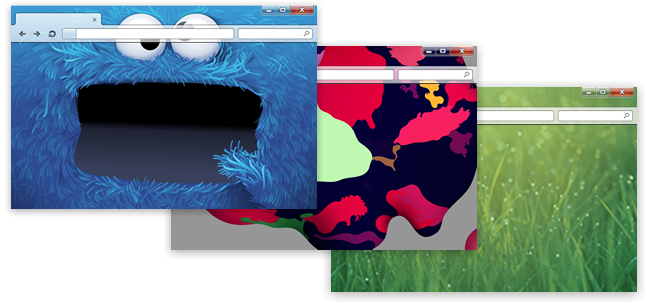
Opera 12.00, code-named Wahoo, is released on June 14, 2012, with themes, camera access for web pages, plug-ins running in their own process and 64-bit builds. Opera 12.10, code-named Marlin, follows on November 6 with SPDY, support for high-resolution Mac screens and touch on Windows 8. It is the last feature release built on Presto.
2013
The end of Presto
On February 13, 2013, Opera announces that it will move to WebKit; in April it joins Google's Blink fork, and Opera 15 is built on Chromium. Opera 12.15, on April 4, is the last update before Opera 15, released on July 2 without Presto and without a mail client; Opera Mail 1.0, the mail client of Opera 12 as a separate program, had been released on June 11. Opera 12.16, on July 4, is the last release for Mac, Linux and FreeBSD.
2014
Opera 12.17
In April 2014, Opera 12.17 brings security fixes to Windows users who stayed with Presto.
2016
Opera 12.18
In February 2016, a last security update for Windows, Opera 12.18, closes the Presto era.
Tabs, from 1995 to 2010
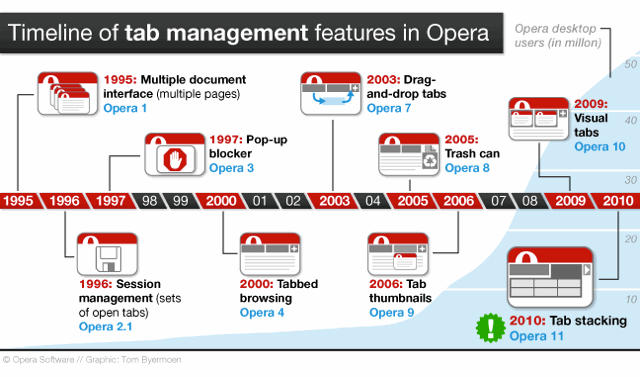
Opera's own timeline of its tab features, from the multiple-document interface of Opera 1 to tab stacking in Opera 11, published in Opera's press releases at the end of 2010.
Sources: Opera's official version history (opera.com/docs/history/presto/), Opera's press releases and company pages kept by the Internet Archive, the Desktop Team blog, and Opera's FTP server for the dates of the last releases.